





Bonavista, Newfoundland. Population 3,190. Big landscape, bigger imagination.
Here, colour is everywhere. Painted saltbox houses. Wildflowers. The Atlantic in a hundred shades of blue and grey. For surface pattern designer Kate Golding, it’s all source material.
Kate turns what she notices into pattern and sends a little piece of Bonavista out into the world.
For The Art of Ease, we joined Kate where the ideas begin.
Kate, what inspires your art?
The inspiration for my designs comes from my natural surroundings and the small details found in daily life. I believe that the way we decorate our spaces can have a direct effect on wellbeing and happiness. When creating designs, I hope to bring joy, lightness and warmth to a home or business. Each design begins as hand-drawn artwork, created either on a tablet or using brushes, ink, and fine-line pens on paper transparencies over a light table.
My designs can be found on collections of wallpaper, art prints, woven blankets and through collaborations with other businesses.

Your fascination with pattern began with your granny’s toile curtains and the textiles inside your family caravan. What did those early spaces teach you about how colour and pattern can shape the way a place feels?
When I think back to the patterns that fascinated me as a child, I remember the sense of wonder they inspired. I can still picture the colour palettes, motifs and the way they transformed ordinary spaces into places that felt comforting, magical and full of character.
Those early experiences taught me that design is incredibly powerful. The spaces we live in have the ability to shape how we feel. They can comfort us during difficult times or uplift, energize and inspire us. I believe every home should feel like a cherished sanctuary; a place of warmth, safety and joy. Pattern, colour and texture all play an important role in creating that atmosphere. They don't simply decorate a room, they help define its character and influence how we experience it every day.

Your work often begins with commonplace details that other people might pass without noticing. What have you learned to pay attention to, and how do you recognize when an ordinary moment contains the beginning of a pattern?
I have learned to trust my intuition and listen to my inner creative voice. To me, that is one of the most rewarding aspects of being an artist. Authenticity is so important, and inspiration is all around us if we take the time to notice it.
I've found that even the simplest moments can become the beginning of a new pattern. It might be the colour palette of book spines on a shelf, the delicate shape of a wildflower on a walk or even the arrangement of food on a dinner plate. These everyday details often hold unexpected beauty.
When something catches my attention, it's usually because it sparks a feeling of curiosity or delight. I've learned to pay attention to those moments and follow them. Sometimes they become the starting point for a new design.
You moved from England to Canada and now create beside the Atlantic in Bonavista. How has living in Newfoundland changed what inspires you, or the way you see familiar subjects?
Although I've lived in Canada for many years, my move to Bonavista, Newfoundland has been profoundly liberating, both personally and creatively.
Living here has immersed me in an extraordinary landscape. The Atlantic coastline, flora, fauna and rugged natural environment provide a constant source of ideas and creative curiosity. But beyond the scenery, making such a significant life change has given me a fresh perspective. It has encouraged growth, self-reflection and a willingness to embrace new ideas in both my life and my work.
That shift in mindset has been just as influential as my surroundings. I'm excited to see how this new chapter continues to shape my creative practice, allowing both the landscape and the experience of living here to naturally find their way into my designs.

Your designs are carefully constructed by hand before becoming repeating digital patterns. How do you preserve the spontaneity or imperfection of the original idea as it moves through such a deliberate process?
One of the things I love most about nature is that nothing is perfectly uniform. A flower petal, a leaf or the curve of a stem all have subtle irregularities and I think those imperfections are what make them beautiful. When I'm drawing motifs, I try to capture that sense of natural character rather than striving for perfection.
Although my designs are refined into repeating patterns, I make a conscious effort to preserve the personality of the original artwork. I rarely want to smooth away every uneven line or tiny quirk, because those details are what make a design feel warm, authentic, and handmade.
My creative process varies from design to design. Sometimes I have a very clear vision from the moment I discover the inspiration, almost like I can already see the finished pattern in my mind. Other times I begin simply by drawing, allowing the motifs to evolve organically before the repeat pattern gradually reveals itself. I enjoy both approaches and I think that balance between intention and discovery helps keep my work feeling alive.

The Art of Ease explores how thoughtful design can make everyday life feel more natural, comforting, and considered. How do you hope your patterns contribute to that sense of ease in the homes and spaces where people live?
Life can often feel busy and complicated, and our homes should offer a sense of balance. To me, a home is more than just the place we live, it’s an environment that nurtures us, restores us and reflects who we are. Thoughtful design has the power to create spaces that feel calming, uplifting and deeply personal.
When I create a pattern, I try to capture not just what I saw, but how I felt when I first discovered the inspiration. My hope is that those emotions resonate with the people who live with my work, becoming part of the atmosphere of their everyday lives.
One of the most rewarding parts of my work is hearing from clients who tell me that a particular design reminds them of a special place or moment in time. Those messages reaffirm my belief that pattern isn't simply decorative, it can evoke emotion, create connection, and help transform a house into a home.
What is your favourite EverEase™ style, and what drew you to it?
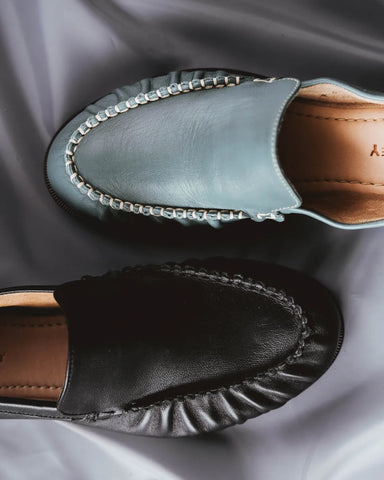
My favourite EverEase™ style is the Eyelet Oxford 2.0 in Storm. I love its timeless silhouette and how comfortable it is. The Storm colour immediately caught my eye. It reminds me of the Atlantic Ocean on a moody day, with all the beautiful depth and subtle variation in its tones. As someone who finds endless inspiration in colour and the natural landscape, it's a colour that feels both grounding and effortlessly wearable.
 Photography by Johnny C.Y. Lam


