














Note: Poppy Barley no longer offers shoes for men.
In the first post in our Shoeology series, we traveled a few hundred years into the past to discover the origins of the Oxford shoe. An Oxford shoe is defined by its "closed" lacing system, meaning that its eyelet tabs are stitched underneath the vamp (i.e., the top) of the shoe so that they aren’t visible. The Derby (our Jasper Derby in black calf and deer is pictured above), on the other hand, can be identified by its "open" lacing system, meaning that its eyelet tabs are stitched on top of the shoe’s vamp. But how—and more importantly, why—did the Derby emerge? What's the point of making such a seemingly trivial change in the way a shoe is designed?
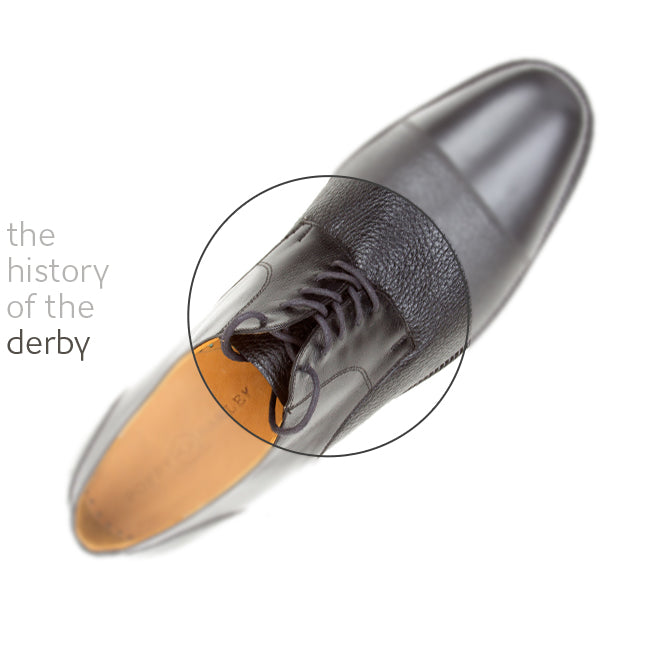 The answer is, of course, that this change from closed to open lacing isn't trivial at all. In fact, it makes quite a big difference. For people with a high instep (which is sometimes attributed to a high arch), the Oxford's closed lacing system sometimes doesn't have enough room. Because the eyelet tabs are stitched on top of the shoe's vamp rather than underneath, a Derby typically has a roomier instep (of course, this is adjustable through lacing). The prevailing theory posits the Derby as an evolution of the Oxford, a response to those who found the Oxford uncomfortable for their high insteps.
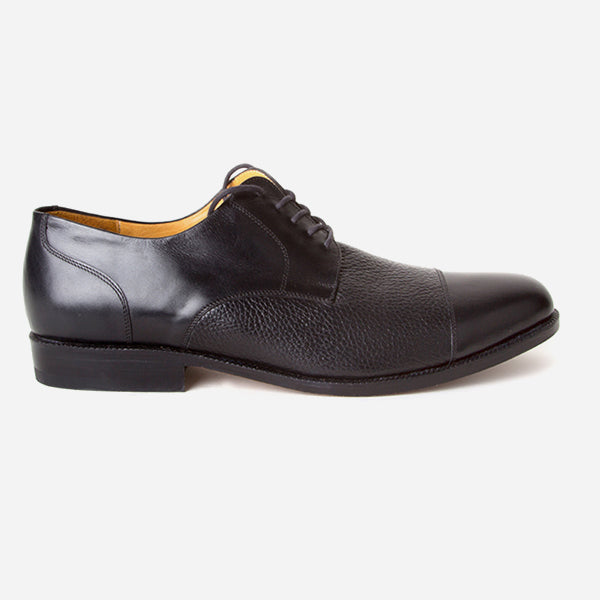

 There's even a third theory to muddle the waters even further. Boots were the standard issue footwear for soldiers in Europe in the 1800s, and anyone who has worn boots could probably tell you they aren't always the easiest the get on and off at the best of times, let alone in the less-than-ideal conditions of war, where soldiers are often trekking through mud and water. During the Napoleonic wars, a Prussian army officer named Gebhard Leberecht von Blücher (explaining the term blucher, another name that is used to describe the Derby, especially in the United States) developed a boot with two leather flaps below the ankles that could be laced together, i.e., it used an open lacing system.
  Just as with the Oxford, the multiple theories floating around suggest that the defining feature of the Derby shoe, its open lacing system, was being developed simultaneously by different people around Europe, which reminds me of the scientific concept of multiple discovery, which hypothesizes that "that most scientific discoveries and inventions are made independently and more or less simultaneously by multiple scientists and inventors." Look at that—not only do you know more about Derby shoes now, but science, too! Who said shoes couldn't be educational?




